Choosing China’s best steel structures can appear straightforward when brochures highlight fast production, competitive pricing, and impressive factory images. However, real performance depends on engineering design, material traceability, fabrication accuracy, transportation, and site installation. A structure that looks excellent in a workshop may face different conditions after exposure to coastal salt, heavy snow, strong wind, or repeated temperature changes.
So, what are the disadvantages of steel structures? Common concerns include corrosion, fire protection costs, thermal bridging, noise transmission, and the need for careful maintenance. Steel can lose strength rapidly during severe fire exposure unless suitable protection is installed. Its high thermal conductivity may also create cold surfaces and condensation inside poorly insulated buildings. These issues become visible in practical details, such as rust forming around damaged coatings or water collecting near poorly designed joints.
Quality control matters greatly.
In project assessments, experienced engineers usually review welding records, coating thickness, bolt connections, load calculations, and inspection reports. They also compare the supplier’s claims with local building codes and actual site conditions. The lowest quotation may not represent the lowest lifecycle cost. Transport damage, replacement parts, repainting, and delayed installation can change the final budget. A polished brochure rarely shows these expenses. That deserves honest reflection.
China has many capable steel structure manufacturers, but “best” is not universal. The right choice depends on climate, building use, fire strategy, maintenance access, and contractor skill. Independent inspections and clear technical documentation can reduce uncertainty. Even then, no system is perfect. Reliable decisions come from comparing evidence, not trusting a label alone.
China produced about 1.02 billion tonnes of crude steel in 2023, according to the World Steel Association’s World Steel in Figures 2024. That volume represented roughly 54% of global output. It shows China’s enormous manufacturing capacity, but production scale does not automatically guarantee consistent structural quality.
Steel structures benefit from high strength, fast fabrication, and recyclable materials. However, disadvantages can appear during sourcing and construction. Large output may create uneven quality between mills, especially when buyers compare only price. Certificates, heat numbers, welding procedures, and third-party inspections remain essential. A small documentation gap can affect an entire warehouse frame.
Energy use is another concern. The International Energy Agency reports that iron and steel production creates about 8% of global energy-related emissions. China’s huge output therefore carries a significant environmental burden. Coal-based production can also increase embodied carbon in beams, columns, and connection plates. Recycled steel helps, but scrap availability and furnace technology vary by region.
There is also a practical weakness. Steel loses strength rapidly in severe fire conditions and needs suitable fire protection. Coastal projects require careful corrosion control, not just thicker paint. In my experience, low-cost quotations often hide transport, coating, inspection, or maintenance expenses. That is where the apparent advantage becomes less clear. The figures are impressive. The assumptions deserve closer review.
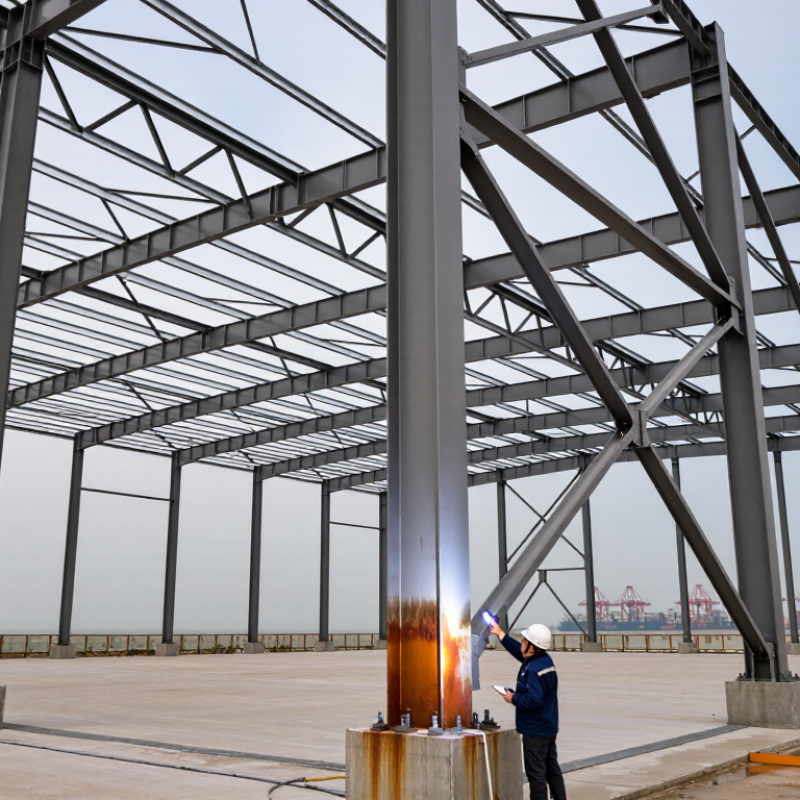
Carbon steel gives structures strength and predictable fabrication, but its corrosion risk deserves close attention. When paint is damaged, water reaches the steel surface and starts an electrochemical reaction. Rust may look harmless. It can steadily reduce section thickness, especially around joints, bolt holes, welds, and trapped-water areas. In coastal or industrial environments, salt and pollutants accelerate this process. A beam can appear sound while losing capacity inside a connection.
Experienced inspectors look beyond color changes. They check coating failure, rust scale, drainage, weld toes, and measured thickness. Ultrasonic testing can identify localized loss that a visual walk-through misses. Remaining thickness should be compared with the original design and applicable engineering requirements.
Small defects are not always small. A neglected scratch may become a recurring maintenance point after every wet season. Many projects become overconfident when coating schedules exist, but surface preparation is rushed. That weakness is practical, not theoretical.
Durable protection begins with detailing that keeps water moving away from steel. Specified coating systems, proper edge treatment, and controlled application conditions reduce exposure. Galvanizing or other protection methods may suit some components, but compatibility and repair procedures require engineering review. Regular inspections should record corrosion locations, thickness readings, photographs, and repair dates. Maintenance budgets must include recoating and access equipment, not only initial construction. I have seen minor rust become expensive when access was delayed. Inspection data can also prevent unnecessary replacement. Good decisions depend on measurements, environment, loading, and competent professional judgment.
Fire exposure is one of structural steel’s clearest disadvantages. Steel does not burn, but it rapidly loses mechanical capacity as temperature rises. EN 1993-1-2 reports a reduction factor of about 0.47 for yield strength at 600°C. In practical terms, a member may retain less than half its room-temperature yield strength. Its elastic modulus also falls sharply, reducing stiffness and increasing deflection. That happens faster than many people expect.
The temperature of a steel column can climb quickly under a developing fire. Unprotected surfaces may show serious distortion before flames reach their peak. Connections, bolts, and restrained beams also face thermal expansion forces. The AISC Design Guide 19 emphasizes that fire resistance depends on the complete assembly, not steel alone. Protective coatings, board systems, concrete encasement, and active suppression can delay heating. They do not remove the risk.
The uncomfortable detail is that “fireproof steel” is an incomplete idea. A protected frame still needs verified fire-resistance ratings, inspection, and realistic loading assumptions. Small gaps in protection can create hot spots. Site damage is easy to overlook. Engineers should check temperature limits, connection behavior, and unplanned restraint using tested or code-based methods. Near 600°C, optimism is not a calculation.
Steel structures offer high strength, but slender members can lose capacity suddenly under compression. Buckling is often the hidden weakness.
AISC 360-22 recommends keeping a compression member’s effective slenderness ratio, KL/r, below 200 where practical. This value is not a safety guarantee. A six-metre, 100 × 100 × 6 mm hollow section illustrates the risk. With pinned ends, a 200 GPa steel modulus, and an estimated second moment of area of 3.34 million mm⁴, Euler’s critical load is only about 183 kN. Its nominal yield capacity may exceed 800 kN, yet instability governs first. The member looks strong. It is not necessarily stable.
Real buildings add imperfections. Slight crookedness, loose connections, residual welding stress, and eccentric loads reduce resistance. Eurocode 3, EN 1993-1-1, therefore applies buckling curves and reduction factors rather than relying on yield strength alone. AISC 360-22 also requires engineers to consider elastic and inelastic buckling modes. Site observations matter here. A column may show no visible damage before its capacity drops sharply. That is uncomfortable.
Bracing spacing deserves close attention. A missing tie can double the effective length, while Euler capacity then falls to roughly one-quarter. Engineers should verify restraint stiffness, connection behavior, and second-order effects. Simplified models can be useful, but they can also hide weakness. Industry guidance is not a substitute for checking the actual frame.
Steel structures can appear economical at purchase, yet lifecycle costs often tell a different story. Steel prices change with energy costs, transport, demand, and production capacity. The OECD’s 2024 steel market analysis projected global excess capacity could reach about 721 million metric tons by 2027. Such pressure may reduce prices temporarily, but it can also create unstable procurement conditions.
Coating maintenance adds another long-term expense. The NACE IMPACT study estimated global corrosion costs at approximately 3.4% of worldwide gross domestic product. Protective coatings reduce exposure, but they do not eliminate inspection, surface preparation, access equipment, or repainting costs. A coastal warehouse may need frequent checks around bolted joints, roof edges, and drainage points. Small coating failures can spread beneath the surface.
Maintenance planning must reflect the actual environment. ISO 12944 classifies atmospheric corrosivity from low to very high, helping engineers select suitable protection systems. However, classification is not a perfect forecast. Local pollution, condensation, poor detailing, and delayed repairs can change performance. An initial estimate may look precise. It may still be wrong. Owners should compare coating intervals, labor rates, inspection access, and future steel prices before approving the design. Otherwise, a low upfront bid can become an expensive maintenance schedule.
Damaged paint lets water reach steel and start an electrochemical reaction. Rust reduces section thickness over time.
Coastal air, industrial pollutants, salt, condensation, and poor drainage accelerate corrosion.
Inspectors should check coating damage, rust scale, drainage, weld toes, and connection areas.
Records should include corrosion locations, thickness readings, photographs, repair dates, and surrounding conditions.
Details should move water away from steel. Proper edge treatment and controlled coating application also help.
Compression members may lose stability because of their shape, length, imperfections, and restraint conditions.
A missing restraint can double the member’s effective length. Euler buckling capacity may then fall to about one-quarter.
Costs include steel prices, transport, coatings, inspections, surface preparation, access equipment, and repainting.
Plans should reflect local pollution, moisture, condensation, drainage, and access conditions.
Steel structures offer high strength, fast construction, and excellent design flexibility, but they also have several limitations. The question “what are the disadvantages of steel structures” is important for anyone evaluating this building method. Although China produced approximately 1.02 billion tonnes of steel in 2023, large-scale production does not eliminate material-related risks. Unprotected carbon steel can corrode when exposed to moisture, chemicals, or harsh environments, gradually reducing its section thickness and load-carrying capacity.
Fire performance is another concern because structural steel can lose most of its strength at temperatures near 600°C, often requiring fire-resistant coatings or protective systems. In addition, slender steel members may buckle under compression if their design, bracing, or connections are inadequate. Finally, lifecycle expenses can increase because steel prices may fluctuate and protective coatings require regular inspection, repair, and renewal. Therefore, proper design, corrosion control, fire protection, and long-term maintenance are essential for achieving safe and cost-effective steel structures.

PYO Homes